


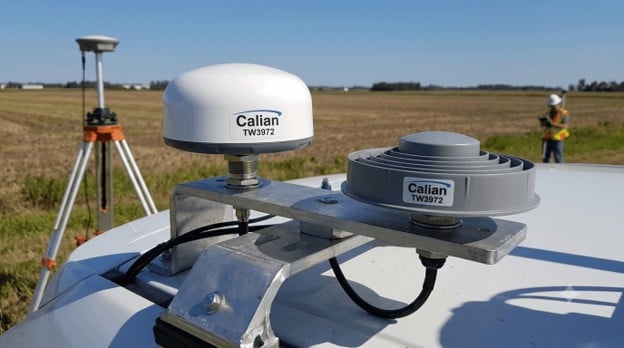
Choosing Calian GNSS antennas is not simply a matter of selecting a component that can receive satellite signals. In a complete GNSS system, antenna characteristics can affect signal quality, multipath susceptibility, interference resistance, positioning consistency, and ultimately how reliably the receiver determines its position.
For applications that depend on more than basic navigation, the antenna deserves to be evaluated as part of the RF system rather than treated as an interchangeable accessory.
Why the GNSS Antenna Matters
A GNSS receiver can only work with the signals delivered to it. The antenna captures weak signals from satellites across the required frequency bands and passes them to the receiver while preserving their useful characteristics.
That makes antenna selection particularly important in environments where the signal landscape is complicated.
A system installed on an open survey site may have very different requirements from one mounted on a vehicle, agricultural machine, UAV, marine platform, or industrial installation. Nearby structures, electronics, transmitters, reflective surfaces, and the physical orientation of the antenna can all affect the RF environment.
This is why Calian GNSS antennas should be evaluated according to the application rather than selected solely by dimensions, connector type, or nominal gain.
Frequency Coverage Determines What the Receiver Can Use
Modern GNSS positioning can draw information from multiple satellite constellations and frequency bands. Depending on the receiver and application, this can include GPS, Galileo, GLONASS, BeiDou, QZSS, and NavIC, along with correction services operating in relevant L-band frequencies.
An antenna therefore needs to provide appropriate coverage for the signals the receiver is designed to process.
Calian’s GNSS portfolio includes antennas supporting different combinations of constellations and frequencies, including single-, dual-, triple-, and full-band configurations. Its selection guide specifically starts with identifying the signal frequency bands and satellite constellations required by the receiver.
For system designers, the important question is not simply whether an antenna is advertised as “GNSS.” It is whether its frequency coverage aligns with the receiver, correction architecture, and accuracy requirements of the complete system.
Multipath Can Turn a Strong Signal Into a Difficult Measurement
One of the less obvious challenges in GNSS positioning is multipath.
Satellite signals can reflect from buildings, vehicles, terrain, water, and other surfaces before reaching the antenna. The receiver may then encounter a combination of direct and reflected signal energy rather than a clean direct path.
The result can be measurement errors even when the receiver appears to have adequate satellite visibility.
Antenna design can help reduce the impact of these unwanted signals. Characteristics such as polarization response, radiation pattern, axial ratio, and multipath rejection therefore matter when a GNSS system operates near reflective surfaces.
This is one reason Calian GNSS antennas can be differentiated by their underlying antenna technologies rather than simply by their physical form. Calian identifies multipath rejection as a performance characteristic across technologies such as Accutenna, VeroStar, and VeraPhase.
For precision applications, reducing problematic reflected-signal contributions can be more meaningful than simply maximizing raw signal gain.
Interference Rejection Is a System-Level Consideration
GNSS signals arriving at the Earth’s surface are relatively weak. As a result, interference from other radio-frequency sources can become an important consideration, particularly in dense or electronically active environments.
Potential interference can come from signals near the GNSS bands as well as stronger out-of-band transmissions. An antenna’s filtering and RF design can therefore influence whether the receiver receives a usable GNSS signal under difficult conditions.
Calian’s portfolio includes antennas with pre-filtering and extended filtering technologies intended to mitigate unwanted RF signals. Its documentation describes applications involving LTE, Inmarsat, and other nearby or out-of-band signals.
This makes filtering particularly relevant for systems operating around communications equipment, vehicles, infrastructure, or other sources of RF activity.
Phase-Center Stability Matters in Precision Positioning
For ordinary navigation, users may primarily care about whether the reported position is accurate enough for the application. High-precision systems have another consideration: the antenna’s phase center.
The effective electrical reference point of an antenna can vary depending on signal frequency and the direction from which a signal arrives. These variations can become important when centimeter-level positioning, surveying, timing, RTK, or PPP is involved.
This is where phase-center variation becomes an important antenna-selection criterion.
Calian’s precision antenna technologies are designed with phase-center stability in mind. For example, the company identifies tight phase-center variation as a characteristic of its VeroStar and VeraPhase technologies, with VeraPhase designed for particularly demanding precision applications.
The practical lesson is straightforward: a precision receiver cannot compensate for every limitation introduced earlier in the RF chain.
Physical Installation Can Change Antenna Performance
Even a well-designed antenna still needs an appropriate installation environment.
Mounting location, nearby materials, ground-plane characteristics, enclosure design, cable routing, and exposure to weather can all influence the behavior of a GNSS antenna.
The installation also needs to match the intended antenna design. Embedded antennas, pole-mounted antennas, vehicle-mounted systems, and lightweight helical antennas may each impose different integration considerations.
Calian, for example, offers both housed and embedded GNSS antenna configurations and provides installation and integration guidance for its products. Its Helical technology is positioned for lightweight applications, including UAVs, drones, and robotics, while other antenna technologies are intended for precision and demanding outdoor applications.
A good specification on paper does not eliminate the need for good RF integration.
Choosing Calian GNSS antennas by Application
The right antenna depends on what the positioning system needs to accomplish.
Before selecting among civilian GNSS antennas, engineers and integrators should consider:
- Required frequency bands: Determine which GNSS signals the receiver actually uses.
- Constellation compatibility: Check whether the system needs GPS alone or multiple constellations such as Galileo, BeiDou, GLONASS, QZSS, or NavIC.
- Accuracy requirements: Surveying, RTK, PPP, timing, and machine-control applications can impose substantially different antenna requirements than basic navigation.
- RF environment: Identify nearby transmitters, communications equipment, and other potential interference sources.
- Multipath exposure: Consider whether buildings, vehicles, water, machinery, or terrain could create significant reflections.
- Mechanical environment: Evaluate size, weight, mounting method, vibration, temperature, moisture, and enclosure requirements.
- Receiver compatibility: Confirm that antenna frequency coverage, gain, power requirements, connectors, and other electrical characteristics match the receiver.
This application-first approach is more reliable than choosing an antenna based on a single specification.
Where Calian GNSS antennas Fit
Calian’s GNSS portfolio, formerly associated with the Tallysman Wireless brand, spans several antenna technologies and configurations. The range includes Accutenna, Helical, VeroStar, and VeraPhase technologies, along with smart GNSS antennas and anti-jamming solutions.
That breadth matters because GNSS deployments are not uniform.
A lightweight robotic platform may prioritize size and weight. A precision agriculture system may place greater emphasis on multipath rejection and multi-frequency coverage. A timing installation may have different phases and environmental requirements. A mission-critical application may require additional protection against interference.
The appropriate choice should therefore follow the system’s actual operating conditions rather than assuming one antenna design is optimal for every deployment.
Questions to Ask Before Buying a GNSS Antenna
Before purchasing Calian GNSS antennas, a technical team can narrow the selection by asking a few practical questions:
- Which GNSS constellations and frequency bands does the receiver require?
- What level of positioning accuracy is expected?
- Will the antenna operate around buildings, vehicles, machinery, or other reflective surfaces?
- Is the installation exposed to significant RF interference?
- Does the application require additional filtering or anti-jamming capabilities?
- Are phase-center characteristics important to the positioning workflow?
- Where will the antenna be mounted, and what ground-plane or enclosure conditions will exist?
- What environmental and mechanical conditions will the antenna experience?
- Does the antenna’s electrical configuration match the receiver and cable system?
- Is the selected antenna intended for the specific application rather than simply compatible with GNSS?
The National Institute of Standards and Technology, a U.S. government agency, also treats GNSS as an important component of positioning, navigation, and timing infrastructure, reinforcing why the performance of the complete signal chain matters rather than viewing the receiver as an isolated component.
The Antenna Is Part of the Positioning System
A GNSS antenna does much more than collect satellite signals. Its frequency coverage, radiation characteristics, multipath rejection, filtering, phase-center behavior, and physical integration can all influence what the receiver ultimately has available to calculate a position.
That is why Calian GNSS antennas should be evaluated in the context of the complete deployment.
For basic navigation, the selection process may be relatively straightforward. For RTK, PPP, precision agriculture, machine control, timing, robotics, UAVs, or other demanding applications, antenna performance can become a much more consequential part of the system design.
The most useful question is therefore not simply, “Which GNSS antenna should I buy?”
It is: What does this positioning system need the antenna to do under its actual operating conditions?
Once that question is answered, selecting the appropriate antenna technology, frequency coverage, filtering, mounting configuration, and environmental design becomes considerably more systematic.